
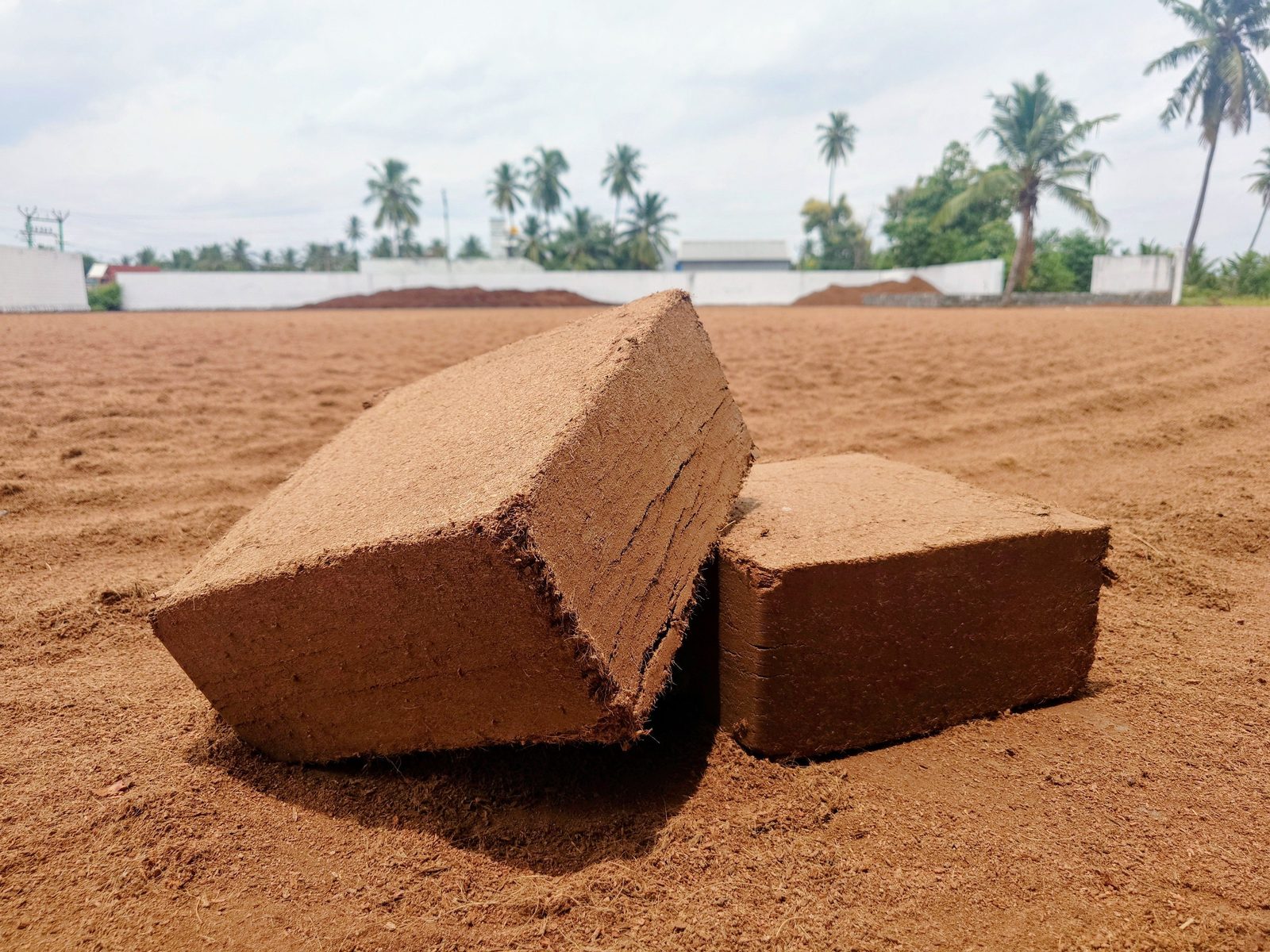
India is the world's largest coir producer, and coir pith — coco peat — made up 59.63% of India's US$ 455 million coir exports in FY 2024-25. When you buy it, three numbers decide whether it works in your system: EC (salt level — under 0.5 dS/m is the low grade under the Bureau of Indian Standards specification), buffering (calcium pre-treatment so the substrate does not lock up calcium and magnesium), and expansion (at least 15 litres per kg, about 75 litres from a 5 kg block). It ships under ITC-HS 5305 00 40 with a phytosanitary certificate, and a lot-specific test report should come with every order and every sample.
India's Coco Peat Market at a Glance
Coir is extracted from coconut husk. The long fibre goes into mats, rope and geotextiles; the spongy material left behind — coir pith, sold as coco peat — is washed, dried, graded and compressed into blocks for horticulture. It is now the single biggest part of India's coir trade.
| Indicator | Figure | Source |
| Coir exports, FY 2024-25 | US$ 455 million | IBEF (Coir Board / DGCIS) |
| Coir pith share of export value, FY 2024-25 | 59.63% | IBEF (Coir Board) |
| Coir exports, FY 2025-26 | US$ 693 million | IBEF |
| India's share of world coir production | Over 70% | IBEF |
| Largest destinations by value share, FY 2025-26 | China 26.79% · USA 16.45% · Netherlands 10.00% | IBEF (Coir Board) |
The buyers of coco peat specifically are greenhouse vegetable growers, berry and cut-flower producers, nurseries, hydroponic and vertical farms, potting-mix blenders and garden retail brands. A large share of China's volume is coir fibre rather than growing media; for pith, the established horticulture markets in North America, Western Europe and East Asia set the quality bar.
The reason coco peat keeps growing is simple: it is a renewable alternative to sphagnum peat, which growers and retailers in Europe are under growing pressure to reduce, and it holds water and air well enough to run hydroponic and drip systems on its own.
EC Grades: Washed, Buffered or Unwashed?
Raw coir pith carries salts from the husk — mainly sodium and potassium. Electrical conductivity (EC) measures that salt load. High-EC material can scorch roots and upset the nutrient balance of a fertigation programme, so EC is the first number on any coco peat specification.
The Bureau of Indian Standards' 2024 specification for coir pith blocks grades material by EC as follows. Note that many suppliers call anything under 1.0 “low EC” — if your crop is sensitive, ask for the BIS grade or a number, not a label.
| Grade | EC (dS/m = mS/cm) | Typical Use |
| Grade I — Low | Below 0.5 | Hydroponics, propagation, salt-sensitive crops |
| Grade II — Medium | 0.5 to 0.8 | Nursery and container growing, potting mixes |
| Grade III — High | Above 0.8 | Soil amendment, blending, tolerant crops |
Washed vs buffered — not the same thing
Washing removes free salts with fresh water, bringing EC down. Buffering is a second step. Coir particles hold positively charged ions; untreated, they release potassium and sodium and then bind the calcium and magnesium your plants need. Buffering pre-loads the coir with calcium — usually calcium nitrate — so it does not steal those nutrients after planting (CANNA explains the mechanism).
- Washed and buffered: hydroponics, rockwool replacement, propagation and any recirculating system. It is the usual choice for commercial greenhouse and soilless production.
- Washed, unbuffered: nurseries and blenders who adjust nutrition themselves or mix coir with other media.
- Unwashed or semi-washed: soil conditioning, landscaping and bulk blending where salt is diluted.
Our coco peat page lists the grades we supply and the parameters stated on every lot.
Specifications to Put in Your Purchase Order
EC alone is not a specification. The table below gives the BIS limits for compressed coir pith blocks, which are a sound baseline for any contract. Add sodium and potassium limits if you are buying buffered material.
| Parameter | 650 g Block | 5 kg Block |
| pH | 5.0 to 7.0 | 5.0 to 7.0 |
| Moisture, max | 20% | 20% |
| Expansion (hydrated volume), min | 10 L per kg | 15 L per kg (≈ 75 L per block) |
| Sand, max | 2% | 2% |
| Fibre content, max | 3% | 3% |
| Particles below 1 mm, max | 20% | 35% |
| Weight tolerance | ±20 g | ±100 g |
Two details cause most disputes. First, EC test method: the reading depends on the water-to-sample ratio of the extract (1:1.5 and 1:3 give different numbers for the same material), so the contract must name the method as well as the limit. Second, moisture at loading: a block shipped at 25% moisture instead of 15% means you are paying freight on water and inviting mould in a hot container.
We publish industry-standard values on our product pages; the actual test report for your lot is supplied with every order and every sample, so you approve against measured numbers rather than a brochure.
Formats: Blocks, Grow Bags, Discs, Chips and Mulch
The same raw material is sold in several forms. Choose by how the product will be handled at your end, not by price per tonne.
| Format | What It Is | Best For |
| Coco peat blocks | 5 kg blocks, plus 650 g, 1 kg and 2 kg bricks; compressed about 5:1 | Bulk growers, potting-mix blenders, retail bricks |
| Coir grow bags | Pre-filled slabs or open-top bags, UV film, drainage and planting holes to your system | Greenhouse tomato, cucumber, pepper, strawberry |
| Coir discs | Compressed pellets, 30–50 mm, expand on watering | Propagation trays, plug production |
| Coir chips | Cut husk pieces, 6–25 mm | Orchids, anthurium, high-drainage blends |
| Coir mulch | Mats, discs, loose fibre and rolls | Weed control, orchards, landscaping, erosion control |
Compression is what makes coco peat economical to ship from India: a 5 kg block occupies a fraction of the volume it expands to. Grow bags and loose chips ship at much lower density, so freight per usable litre is higher — worth checking before you compare quotes across formats.
HS Code and Export Documents
India classifies coir pith under ITC-HS 5305 00 40, which covers coir pith in loose form and in value-added forms such as briquettes, coins (discs) and grow bags. The six-digit root, 5305.00, is the one every customs authority recognises; your importer's broker adds the national digits. Confirm the full code against the destination tariff before shipping — see our HS codes reference.
| Document | Issued By | Notes |
| Commercial invoice & packing list | Exporter | Block count, net and gross weight, HS code consistent across all papers |
| Bill of lading | Shipping line | Original or telex release as agreed |
| Certificate of origin | Authorised agency | Preferential origin where a trade agreement applies |
| Phytosanitary certificate | India's Plant Quarantine Organisation | Required by most importing countries for coir pith |
| Lot test report | Testing laboratory | EC, pH, moisture, expansion; sodium and potassium for buffered grades |
| Fumigation or treatment certificate | Approved operator | Only where the importing country requires it |
Australia and New Zealand apply their own biosecurity conditions to plant-based growing media. Check the current import conditions in Australia's BICON or with New Zealand's Ministry for Primary Industries before booking, and share them with your supplier at the quotation stage. The full document set for Indian exports is in our export documents checklist.
Buyer Checklist Before You Order
- State EC as a number and a method — for example “below 0.5 dS/m, 1:1.5 extract” — not just “low EC”.
- Specify buffered or unbuffered, and for buffered material, a sodium limit in the test report.
- Fix the block format: weight, dimensions and tolerance, compression, and expansion volume per kg.
- Set a moisture limit at loading and ask for the measured value on the test report.
- Approve a pre-shipment sample with its own report, and test it in your own system before committing a container.
- Agree packing and loading: palletised or floor-loaded, wrapping, and labelling for your warehouse.
- Collect destination conditions early: phytosanitary wording, treatment requirements and any import permit.
At Zenvico Global the specification is agreed in writing before production, every lot is tested against it, and the report travels with the shipment. MOQ is discussed at order stage and quotes are FOB or CIF.
Frequently Asked Questions
What is coco peat?
Coco peat, also called coir pith or coco coir, is the spongy material left after fibre is extracted from coconut husk. It is washed, dried, graded and compressed into blocks, discs or grow bags and used as a soilless growing medium and as a renewable alternative to sphagnum peat.
What does buffered coco peat mean?
Buffered coco peat has been treated with a calcium solution, usually calcium nitrate, after washing. This pre-loads the coir with calcium so it does not release excess potassium and sodium or bind the calcium and magnesium plants need. Buffered material is the standard choice for hydroponics and propagation.
What EC should good coco peat have?
Under the Bureau of Indian Standards specification for coir pith blocks, the low grade (Grade I) is below 0.5 dS/m, the medium grade is 0.5 to 0.8, and the high grade is above 0.8. Sensitive crops and hydroponic systems need the low grade. Always agree the test method as well as the limit.
How many litres does a 5 kg coco peat block make?
The BIS specification sets a minimum expansion of 15 litres per kilogram for 5 kg blocks, so a compliant 5 kg block should give at least about 75 litres of growing medium when hydrated. Smaller 650 g bricks have a minimum of 10 litres per kilogram.
What is the HS code for coco peat from India?
India exports coir pith under ITC-HS 5305 00 40, which covers loose coir pith and value-added forms such as briquettes, coins or discs and grow bags. The internationally recognised six-digit root is 5305.00; the importing country adds its own national digits.
Which documents does a coco peat shipment need?
A commercial invoice, packing list, bill of lading, certificate of origin, a phytosanitary certificate from India's Plant Quarantine Organisation and a lot test report covering EC, pH, moisture and expansion. Some countries, including Australia and New Zealand, set additional biosecurity conditions that must be checked before shipping.
Figures are taken from the sources linked in this guide and were current at the time of writing. Specifications shown are industry-standard values; the actual test report for your lot is supplied with every order and every sample. Destination requirements change — confirm import conditions with the relevant authority before shipping.
Get a Coco Peat Quote with the Spec Agreed First
Tell us your crop, system and destination. We agree EC, buffering and block format in writing, and quote FOB or CIF within 24 hours.